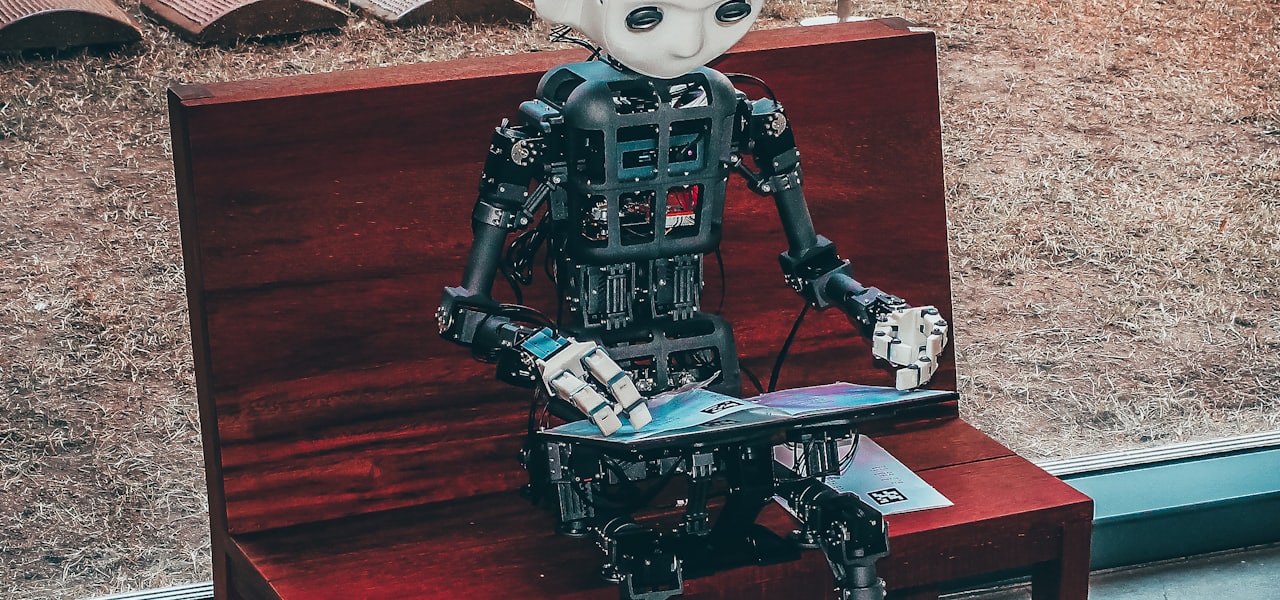
Selmer Bringsjord (born November 24, 1958) is a professor of computer science and cognitive science and a former chair of the Department of Cognitive Science at Rensselaer Polytechnic Institute. He also holds an appointment in the Lally School of Management & Technology and teaches artificial Intelligence (AI), formal logic, human and machine reasoning, and philosophy of AI. == Biography == Bringsjord's education includes a B.A. in philosophy from the University of Pennsylvania and a Ph.D. in philosophy from Brown University, where he studied under Roderick Chisholm. He conducts research in AI as the director of the Rensselaer AI & Reasoning (RAIR) Laboratory. He specializes in the logico-mathematical and philosophical foundations of AI and cognitive science, and in collaboratively building AI systems on the basis of computational logic. Bringsjord believes that "the human mind will forever be superior to AI", and that "much of what many humans do for a living will be better done by indefatigable machines who require not a cent in pay". Bringsjord has stated that the "ultimate growth industry will be building smarter and smarter such machines on the one hand, and philosophizing about whether they are truly conscious and free on the other". Bringsjord has an argument for P = NP using digital physics. Other research includes developing a new computational-logic framework allowing the formalization of deliberative multi-agent "mindreading" as applied to the realm of nuclear strategy, with the goal of creating a model and simulation to enable reliable prediction. He has published an opinion piece advocating for counter-terrorism security ensured by pervasive, all-seeing sensors; automated reasoners; and autonomous, lethal robots. Bringsjord received a National Science Foundation award to research Social Robotics and the Covey Award for the advancement of philosophy of computing awarded by the International Association for Computing And Philosophy, among several others prizes. == Books authored == with Yang, Y. Mental Metalogic: A New, Unifying Theory of Human and Machine Reasoning (Mahwah, NJ: Lawrence Erlbaum).(2007) with Zenzen, M. Superminds: People Harness Hypercomputation, and More (Dordrecht, The Netherlands: Kluwer). (2003) ISBN 978-1402010958 with Ferrucci, D. Artificial Intelligence and Literary Creativity: Inside the Mind of Brutus, A Storytelling Machine (Mahwah, NJ: Lawrence Erlbaum).(2000) Abortion: A Dialogue (Indianapolis, IN: Hackett).(1997) What Robots Can and Can’t Be (Dordrecht, The Netherlands: Kluwer).(1992) Soft Wars (New York, NY: Penguin USA). A novel.(1991)
Surrogate model
A surrogate model is an engineering method used when an outcome of interest cannot be easily measured or computed, so an approximate mathematical model of the outcome is used instead. Most engineering design problems require experiments and/or simulations to evaluate design objective and constraint functions as a function of design variables. For example, in order to find the optimal airfoil shape for an aircraft wing, an engineer simulates the airflow around the wing for different shape variables (e.g., length, curvature, material, etc.). For many real-world problems, however, a single simulation can take many minutes, hours, or even days to complete. As a result, routine tasks such as design optimization, design space exploration, sensitivity analysis and "what-if" analysis become impossible since they require thousands or even millions of simulation evaluations. One way of alleviating this burden is by constructing approximation models, known as surrogate models, metamodels or emulators, that mimic the behavior of the simulation model as closely as possible while being computationally cheaper to evaluate. Surrogate models are constructed using a data-driven, bottom-up approach. The exact, inner working of the simulation code is not assumed to be known (or even understood), relying solely on the input-output behavior. A model is constructed based on modeling the response of the simulator to a limited number of intelligently chosen data points. This approach is also known as behavioral modeling or black-box modeling, though the terminology is not always consistent. When only a single design variable is involved, the process is known as curve fitting. Though using surrogate models in lieu of experiments and simulations in engineering design is more common, surrogate modeling may be used in many other areas of science where there are expensive experiments and/or function evaluations. == Goals == The scientific challenge of surrogate modeling is the generation of a surrogate that is as accurate as possible, using as few simulation evaluations as possible. The process comprises three major steps which may be interleaved iteratively: Sample selection (also known as sequential design, optimal experimental design (OED) or active learning) Construction of the surrogate model and optimizing the model parameters (i.e., bias-variance tradeoff) Appraisal of the accuracy of the surrogate. The accuracy of the surrogate depends on the number and location of samples (expensive experiments or simulations) in the design space. A systematic data representation during training can improve model scalability, thereby reducing the need for expensive simulations. Various design of experiments (DOE) techniques cater to different sources of errors, in particular, errors due to noise in the data or errors due to an improper surrogate model. == Types of surrogate models == Popular surrogate modeling approaches are: polynomial response surfaces; kriging; more generalized Bayesian approaches; gradient-enhanced kriging (GEK); radial basis function; support vector machines; space mapping; artificial neural networks and Bayesian networks. Other methods recently explored include Fourier surrogate modeling , random forests, convolutional neural networks, and generative adversarial networks. For some problems, the nature of the true function is not known a priori, and therefore it is not clear which surrogate model will be the most accurate one. In addition, there is no consensus on how to obtain the most reliable estimates of the accuracy of a given surrogate. Many other problems have known physics properties. In these cases, physics-based surrogates such as space-mapping based models are commonly used. == Invariance properties == Recently proposed comparison-based surrogate models (e.g., ranking support vector machines) for evolutionary algorithms, such as CMA-ES, allow preservation of some invariance properties of surrogate-assisted optimizers: Invariance with respect to monotonic transformations of the function (scaling) Invariance with respect to orthogonal transformations of the search space (rotation) == Applications == An important distinction can be made between two different applications of surrogate models: design optimization and design space approximation (also known as emulation). In surrogate model-based optimization, an initial surrogate is constructed using some of the available budgets of expensive experiments and/or simulations. The remaining experiments/simulations are run for designs which the surrogate model predicts may have promising performance. The process usually takes the form of the following search/update procedure. Initial sample selection (the experiments and/or simulations to be run) Construct surrogate model Search surrogate model (the model can be searched extensively, e.g., using a genetic algorithm, as it is cheap to evaluate) Run and update experiment/simulation at new location(s) found by search and add to sample Iterate steps 2 to 4 until out of time or design is "good enough" Depending on the type of surrogate used and the complexity of the problem, the process may converge on a local or global optimum, or perhaps none at all. In design space approximation, one is not interested in finding the optimal parameter vector, but rather in the global behavior of the system. Here the surrogate is tuned to mimic the underlying model as closely as needed over the complete design space. Such surrogates are a useful, cheap way to gain insight into the global behavior of the system. Optimization can still occur as a post-processing step, although with no update procedure (see above), the optimum found cannot be validated. == Surrogate modeling software == Surrogate Modeling Toolbox (SMT: https://github.com/SMTorg/smt) is a Python package that contains a collection of surrogate modeling methods, sampling techniques, and benchmarking functions. This package provides a library of surrogate models that is simple to use and facilitates the implementation of additional methods. SMT is different from existing surrogate modeling libraries because of its emphasis on derivatives, including training derivatives used for gradient-enhanced modeling, prediction derivatives, and derivatives with respect to the training data. It also includes new surrogate models that are not available elsewhere: kriging by partial-least squares reduction and energy-minimizing spline interpolation. Python library SAMBO Optimization supports sequential optimization with arbitrary models, with tree-based models and Gaussian process models built in. Surrogates.jl is a Julia packages which offers tools like random forests, radial basis methods and kriging. == Surrogate-Assisted Evolutionary Algorithms (SAEAs) == SAEAs are an advanced class of optimization techniques that integrate evolutionary algorithms (EAs) with surrogate models. In traditional EAs, evaluating the fitness of candidate solutions often requires computationally expensive simulations or experiments. SAEAs address this challenge by building a surrogate model, which is a computationally inexpensive approximation of the objective function or constraint functions. The surrogate model serves as a substitute for the actual evaluation process during the evolutionary search. It allows the algorithm to quickly estimate the fitness of new candidate solutions, thereby reducing the number of expensive evaluations needed. This significantly speeds up the optimization process, especially in cases where the objective function evaluations are time-consuming or resource-intensive. SAEAs typically involve three main steps: (1) building the surrogate model using a set of initial sampled data points, (2) performing the evolutionary search using the surrogate model to guide the selection, crossover, and mutation operations, and (3) periodically updating the surrogate model with new data points generated during the evolutionary process to improve its accuracy. By balancing exploration (searching new areas in the solution space) and exploitation (refining known promising areas), SAEAs can efficiently find high-quality solutions to complex optimization problems. They have been successfully applied in various fields, including engineering design, machine learning, and computational finance, where traditional optimization methods may struggle due to the high computational cost of fitness evaluations.
Ciphertext
In cryptography, ciphertext or cyphertext is the result of encryption performed on plaintext using an algorithm, called a cipher. Ciphertext is also known as encrypted or encoded information because it contains a form of the original plaintext that is unreadable by a human or computer without the proper cipher to decrypt it. This process prevents the loss of sensitive information via hacking. Decryption, the inverse of encryption, is the process of turning ciphertext into readable plaintext. Ciphertext is not to be confused with codetext, because the latter is a result of a code, not a cipher. == Conceptual underpinnings == Let m {\displaystyle m\!} be the plaintext message that Alice wants to secretly transmit to Bob and let E k {\displaystyle E_{k}\!} be the encryption cipher, where k {\displaystyle _{k}\!} is a cryptographic key. Alice must first transform the plaintext into ciphertext, c {\displaystyle c\!} , in order to securely send the message to Bob, as follows: c = E k ( m ) . {\displaystyle c=E_{k}(m).\!} In a symmetric-key system, Bob knows Alice's encryption key. Once the message is encrypted, Alice can safely transmit it to Bob (assuming no one else knows the key). In order to read Alice's message, Bob must decrypt the ciphertext using E k − 1 {\displaystyle {E_{k}}^{-1}\!} which is known as the decryption cipher, D k : {\displaystyle D_{k}:\!} D k ( c ) = D k ( E k ( m ) ) = m . {\displaystyle D_{k}(c)=D_{k}(E_{k}(m))=m.\!} Alternatively, in a non-symmetric key system, everyone, not just Alice and Bob, knows the encryption key; but the decryption key cannot be inferred from the encryption key. Only Bob knows the decryption key D k , {\displaystyle D_{k},} and decryption proceeds as D k ( c ) = m . {\displaystyle D_{k}(c)=m.} == Types of ciphers == The history of cryptography began thousands of years ago. Cryptography uses a variety of different types of encryption. Earlier algorithms were performed by hand and are substantially different from modern algorithms, which are generally executed by a machine. === Historical ciphers === Historical pen and paper ciphers used in the past are sometimes known as classical ciphers. They include: Substitution cipher: the units of plaintext are replaced with ciphertext (e.g., Caesar cipher and one-time pad) Polyalphabetic substitution cipher: a substitution cipher using multiple substitution alphabets (e.g., Vigenère cipher and Enigma machine) Polygraphic substitution cipher: the unit of substitution is a sequence of two or more letters rather than just one (e.g., Playfair cipher) Transposition cipher: the ciphertext is a permutation of the plaintext (e.g., rail fence cipher) Historical ciphers are not generally used as a standalone encryption technique because they are quite easy to crack. Many of the classical ciphers, with the exception of the one-time pad, can be cracked using brute force. === Modern ciphers === Modern ciphers are more secure than classical ciphers and are designed to withstand a wide range of attacks. An attacker should not be able to find the key used in a modern cipher, even if they know any specifics about the plaintext and its corresponding ciphertext. Modern encryption methods can be divided into the following categories: Private-key cryptography (symmetric key algorithm): one shared key is used for encryption and decryption Public-key cryptography (asymmetric key algorithm): two different keys are used for encryption and decryption In a symmetric key algorithm (e.g., DES, AES), the sender and receiver have a shared key established in advance: the sender uses the shared key to perform encryption; the receiver uses the shared key to perform decryption. Symmetric key algorithms can either be block ciphers or stream ciphers. Block ciphers operate on fixed-length groups of bits, called blocks, with an unvarying transformation. Stream ciphers encrypt plaintext digits one at a time on a continuous stream of data, with the transformation of successive digits varying during the encryption process. In an asymmetric key algorithm (e.g., RSA), there are two different keys: a public key and a private key. The public key is published, thereby allowing any sender to perform encryption. The private key is kept secret by the receiver, thereby allowing only the receiver to correctly perform decryption. == Cryptanalysis == Cryptanalysis (also referred to as codebreaking or cracking the code) is the study of applying various methodologies to obtain the meaning of encrypted information, without having access to the cipher required to correctly decrypt the information. This typically involves gaining an understanding of the system design and determining the cipher. Cryptanalysts can follow one or more attack models to crack a cipher, depending upon what information is available and the type of cipher being analyzed. Ciphertext is generally the most easily obtained part of a cryptosystem and therefore is an important part of cryptanalysis. === Attack models === Ciphertext-only: the cryptanalyst has access only to a collection of ciphertexts or code texts. This is the weakest attack model because the cryptanalyst has limited information. Modern ciphers rarely fail under this attack. Known-plaintext: the attacker has a set of ciphertexts to which they know the corresponding plaintext Chosen-plaintext attack: the attacker can obtain the ciphertexts corresponding to an arbitrary set of plaintexts of their own choosing Batch chosen-plaintext attack: where the cryptanalyst chooses all plaintexts before any of them are encrypted. This is often the meaning of an unqualified use of "chosen-plaintext attack". Adaptive chosen-plaintext attack: where the cryptanalyst makes a series of interactive queries, choosing subsequent plaintexts based on the information from the previous encryptions. Chosen-ciphertext attack: the attacker can obtain the plaintexts corresponding to an arbitrary set of ciphertexts of their own choosing Adaptive chosen-ciphertext attack Indifferent chosen-ciphertext attack Related-key attack: similar to a chosen-plaintext attack, except the attacker can obtain ciphertexts encrypted under two different keys. The keys are unknown, but the relationship between them is known (e.g., two keys that differ in the one bit). == Famous ciphertexts == The Babington Plot ciphers The Shugborough inscription The Zimmermann Telegram The Magic Words are Squeamish Ossifrage The cryptogram in "The Gold-Bug" Beale ciphers Kryptos Zodiac Killer ciphers
Content-oriented workflow models
In data management, a content-oriented workflow model seeks to articulate workflow progression by the presence of content units (like data-records/objects/documents). Most content-oriented workflow approaches provide a life-cycle model for content units, such that workflow progression can be qualified by conditions on the state of the units. Most approaches are research and work in progress and the content models and life-cycle models are more or less formalized. The term content-oriented workflows is an umbrella term for several scientific workflow approaches, namely "data-driven", "resource-driven", "artifact-centric", "object-aware", and "document-oriented". Thus, the meaning of "content" ranges from simple data attributes to self-contained documents; the term "content-oriented workflows" appeared at first in as an umbrella term. Such a general term, independent from a specific approach, is necessary to contrast the content-oriented modelling principle with traditional activity-oriented workflow models (like Petri nets or BPMN) where a workflow is driven by a control flow and where the content production perspective is neglected or even missing. The term "content" was chosen to subsume the different levels in granularity of the content units in the respective workflow models; it was also chosen to make associations with content management. Both terms "artifact-centric" and "data-driven" would also be good candidates for an umbrella term, but each is closely related to a specific approach of a single working group. The "artifact-centric" group itself (i.e. IBM Research) has generalized the characteristics of their approach and has used "information-centric" as an umbrella term in. Yet, the term information is too unspecific in the context of computer science, thus, "content-orientated workflows" is considered as good compromise. == Workflow Model Approaches == === Data-driven === The data-driven process structures provides a sophisticated workflow model being specialized on hierarchical write-and-review-processes. The approach provides interleaved synchronization of sub-processes and extends activity diagrams. Unfortunately, the COREPRO prototype implementation is not publicly available. Research on the project had been ceased. The general idea has been continued by Reichert in form of the #Object-aware approach. Synonyms data-driven process structures / data-driven modeling and coordination Protagonists Dr. Dominic Müller (University of Twente), Joachim Herbst (DaimlerChrysler Research), and Manfred Reichert (at this time Assoc. Prof. at Univ. of Twente, currently Prof. at Ulm Univ.) Organization(s) University of Twente, DaimlerChrysler Period 2005 - 2007 Selected publications Implementation COREPRO === Resource-driven === The resource-driven workflow system is an early approach that considered workflows from a content-oriented perspective and emphasizes on the missing support for plain document-driven processes by traditional activity-oriented workflow engines. The resource-driven approach demonstrated the application of database triggers for handling workflow events. Still the system implementation is centralized and the workflow schema is statically defined. The project appeared in 2005 but many aspects are considered future work by the authors. Research did not continue on the project. Wang completed his PhD thesis in 2009, yet, his thesis does not mention the resource-driven approach to workflow modelling but is about discrete event simulation. Synonyms Resource-based Workflows / Document-Driven Workflow Systems Protagonists Jianrui Wang and Prof. Akhil Kumar Organization Pennsylvania State University Period 2005 - today Selected publications Implementation N/A === Artifact-centric === The artifact-centric approach provides a framework for content-oriented workflows. In this model, the enterprise application landscape includes distributed business services, while the workflow engine is centralized. Process enactment is integrated with database management system infrastructure, and the project is funded by IBM. Synonyms artifact-centric business process models / artifact-based business process (ACP) / artifact-centric workflows Protagonists Richard Hull and Dr. Kamal Bhattacharya as well as Cagdas E. Gerede and Jianwen Su Organization IBM (T.J. Watson Research Center, NY) Period 2007 - today Selected publications Implementation ArtiFact === Object-aware === The object-aware approach manages a set of object types and generates forms for creating object instances. The form completion flow is controlled by transitions between object configurations each describing a progressing set of mandatory attributes. Each object configuration is named by an object state. The data production flow is user-shifting and it is discrete by defining a sequence of object states. The discussion is currently limited to a centralized system, without any workflows across different organizations. However, the approach is of great relevance to many domains like concurrent engineering. Finally, the object-aware approach and its PHILharmonicFlows system are going to provide general-purpose workflow systems for generic enactment of data production processes. Synonyms object-aware process management / datenorientiertes Prozess-Management-System Protagonists Vera Künzle and Prof. Manfred Reichert Organization Ulm University Period 2009 - today Selected publications Implementation PHILharmonicFlows === Distributed Document-oriented === Distributed document-oriented process management (dDPM) enables distributed case handling in heterogeneous system environments and it is based on document-oriented integration. The workflow model reflects the paper-based working practice in inter-institutional healthcare scenarios. It targets distributed knowledge-driven ad hoc workflows, wherein distributed information systems are required to coordinate work with initially unknown sets of actors and activities. The distributed workflow engine supports process planning & process history as well as participant management and process template creation with import/export. The workflow engine embeds a functional fusion of 1) group-based instant messaging 2) with a shared work list editor 3) with version control. The software implementation of dDPM is α-Flow which is available as open source. dDPM and α-Flow provide a content-oriented approach to schema-less workflows. The complete distributed case handling application is provided in form of a single active Document ("α-Doc"). The α-Doc is a case file (as information carrier) with an embedded workflow engine (in form of active properties). Inviting process participants is equivalent to providing them with a copy of an α-Doc, copying it like an ordinary desktop file. All α-Docs that belong to the same case can synchronize each other, based on the participant management, electronic postboxes, store-and-forward messaging, and an offline-capable synchronization protocol. Synonyms distributed document-oriented process management (dDPM), distributed case handling via active documents Protagonists Christoph P. Neumann and Prof. Richard Lenz Organization Friedrich-Alexander-Universität Erlangen-Nürnberg Period 2009 - 2012 Selected Publications and a PhD thesis Implementation α-Flow (open source) == Related Concepts == === Content Management === The bandwidth of Content management systems (CMS) reaches from Web content management systems (WCMS) and Document management system (DMS) to Enterprise Content Management (ECM). Mature DMS products support document production workflows in a basic form, primarily focusing on review cycle workflows concerning a single document. === Groupware and Computer-Supported Cooperative Work === Groupware focuses on messaging (like E-Mail, Chat, and Instant Messaging), shared calendars (e.g. Lotus Notes, Microsoft Outlook with Exchange Server), and conferencing (e.g. Skype). Groupware overlaps with Computer-supported cooperative work (CSCW), that originated from shared multimedia editors (for live drawing/sketching) and synchronous multi-user applications like desktop sharing. The extensive conceptual claim of CSWC must be put into perspective by its actual solution scope, that is available as the CSCW Matrix. === Case Handling === The case handling paradigm stems from Prof. van der Aalst and gained momentum in 2005. The core features are: (a) provide all information available, i.e. present the case as a whole rather than showing bits and pieces, (b) decide about activities on the basis of the information available rather than the activities already executed, (c) separate work distribution from authorization and allow for additional types of roles, not just the execute role, and (d) allow workers to view and add/modify data before or after the corresponding activities have been executed. In healthcare, the flow of a patient between healthcare professionals is considered as a workflow - with activities that inc
Letter frequency
Letter frequency is the number of times letters of the alphabet appear on average in written language. Letter frequency analysis dates back to the Arab mathematician Al-Kindi (c. AD 801–873), who formally developed the method to break ciphers. Letter frequency analysis gained importance in Europe with the development of movable type in AD 1450, wherein one must estimate the amount of type required for each letterform. Linguists use letter frequency analysis as a rudimentary technique for language identification, where it is particularly effective as an indication of whether an unknown writing system is alphabetic, syllabic, or logographic. The use of letter frequencies and frequency analysis plays a fundamental role in cryptograms and several word puzzle games, including hangman, Scrabble, Wordle and the television game show Wheel of Fortune. One of the earliest descriptions in classical literature of applying the knowledge of English letter frequency to solving a cryptogram is found in Edgar Allan Poe's famous story "The Gold-Bug", where the method is successfully applied to decipher a message giving the location of a treasure hidden by Captain Kidd. Herbert S. Zim, in his classic introductory cryptography text Codes and Secret Writing, gives the English letter frequency sequence as "ETAON RISHD LFCMU GYPWB VKJXZQ", the most common letter pairs as "TH HE AN RE ER IN ON AT ND ST ES EN OF TE ED OR TI HI AS TO", and the most common doubled letters as "LL EE SS OO TT FF RR NN PP CC". Different ways of counting can produce somewhat different orders. Letter frequencies also have a strong effect on the design of some keyboard layouts. The most frequent letters are placed on the home row of the Blickensderfer typewriter, the Dvorak keyboard layout, Colemak and other optimized layouts, while the commonly used QWERTY layout places common letters apart from each other to prevent typewriter jamming. == Background == The frequency of letters in text has been studied for use in cryptanalysis, and frequency analysis in particular, dating back to the Arab mathematician al-Kindi (c. AD 801–873 ), who formally developed the method (the ciphers breakable by this technique go back at least to the Caesar cipher used by Julius Caesar, so this method could have been explored in classical times). Letter frequency analysis gained additional importance in Europe with the development of movable type in AD 1450, wherein one must estimate the amount of type required for each letterform, as evidenced by the variations in letter compartment size in typographer's type cases. No exact letter frequency distribution underlies a given language, since all writers write slightly differently. However, most languages have a characteristic distribution which is strongly apparent in longer texts. Even language changes as extreme as from Old English to modern English (regarded as mutually unintelligible) show strong trends in related letter frequencies: over a small sample of Biblical passages, from most frequent to least frequent, enaid sorhm tgþlwu æcfy ðbpxz of Old English compares to eotha sinrd luymw fgcbp kvjqxz of modern English, with the most extreme differences concerning letterforms not shared. Linotype machines for the English language assumed the letter order, from most to least common, to be etaoin shrdlu cmfwyp vbgkqj xz based on the experience and custom of manual compositors. The equivalent for the French language was elaoin sdrétu cmfhyp vbgwqj xz. Arranging the alphabet in Morse into groups of letters that require equal amounts of time to transmit, and then sorting these groups in increasing order, yields e it san hurdm wgvlfbk opxcz jyq. Letter frequency was used by other telegraph systems, such as the Murray Code. Similar ideas are used in modern data-compression techniques such as Huffman coding. Letter frequencies, like word frequencies, tend to vary, both by writer and by subject. For instance, ⟨d⟩ occurs with greater frequency in fiction, as most fiction is written in past tense and thus most verbs will end in the inflectional suffix -ed / -d. One cannot write an essay about x-rays without using ⟨x⟩ frequently, and the essay will have an idiosyncratic letter frequency if the essay is about, say, Queen Zelda of Zanzibar requesting X-rays from Qatar to examine hypoxia in zebras. Different authors have habits which can be reflected in their use of letters. Hemingway's writing style, for example, is visibly different from Faulkner's. Letter, bigram, trigram, word frequencies, word length, and sentence length can be calculated for specific authors and used to prove or disprove authorship of texts, even for authors whose styles are not so divergent. Accurate average letter frequencies can only be gleaned by analyzing a large amount of representative text. With the availability of modern computing and collections of large text corpora, such calculations are easily made. Examples can be drawn from a variety of sources (press reporting, religious texts, scientific texts and general fiction) and there are differences especially for general fiction with the position of ⟨h⟩ and ⟨i⟩, with ⟨h⟩ becoming more common. Different dialects of a language will also affect a letter's frequency. For example, an author in the United States would produce something in which ⟨z⟩ is more common than an author in the United Kingdom writing on the same topic: words like "analyze", "apologize", and "recognize" contain the letter in American English, whereas the same words are spelled "analyse", "apologise", and "recognise" in British English. This would highly affect the frequency of the letter ⟨z⟩, as it is rarely used by British writers in the English language. The "top twelve" letters constitute about 80% of the total usage. The "top eight" letters constitute about 65% of the total usage. Letter frequency as a function of rank can be fitted well by several rank functions, with the two-parameter Cocho/Beta rank function being the best. Another rank function with no adjustable free parameter also fits the letter frequency distribution reasonably well (the same function has been used to fit the amino acid frequency in protein sequences.) A spy using the VIC cipher or some other cipher based on a straddling checkerboard typically uses a mnemonic such as "a sin to err" (dropping the second "r") or "at one sir" to remember the top eight characters. == Relative frequencies of letters in the English language == There are three ways to count letter frequency that result in very different charts for common letters. The first method, used in the chart below, is to count letter frequency in lemmas of a dictionary. The lemma is the word in its canonical form. The second method is to include all word variants when counting, such as "abstracts", "abstracted" and "abstracting" and not just the lemma of "abstract". This second method results in letters like ⟨s⟩ appearing much more frequently, such as when counting letters from lists of the most used English words on the Internet. ⟨s⟩ is especially common in inflected words (non-lemma forms) because it is added to form plurals and third person singular present tense verbs. A final method is to count letters based on their frequency of use in actual texts, resulting in certain letter combinations like ⟨th⟩ becoming more common due to the frequent use of common words like "the", "then", "both", "this", etc. Absolute usage frequency measures like this are used when creating keyboard layouts or letter frequencies in old fashioned printing presses. An analysis of entries in the Concise Oxford dictionary, ignoring frequency of word use, gives an order of "EARIOTNSLCUDPMHGBFYWKVXZJQ". The letter-frequency table above is taken from Pavel Mička's website, which cites Robert Lewand's Cryptological Mathematics. According to Lewand, arranged from most to least common in appearance, the letters are: etaoinshrdlcumwfgypbvkjxqz. Lewand's ordering differs slightly from others, such as Cornell University Math Explorer's Project, which produced a table after measuring 40,000 words. In English, the space character occurs almost twice as frequently as the top letter (⟨e⟩) and the non-alphabetic characters (digits, punctuation, etc.) collectively occupy the fourth position (having already included the space) between ⟨t⟩ and ⟨a⟩. == Relative frequencies of the first letters of a word in the English language == The frequency of the first letters of words or names is helpful in pre-assigning space in physical files and indexes. Given 26 filing cabinet drawers, rather than a 1:1 assignment of one drawer to one letter of the alphabet, it is often useful to use a more equal-frequency-letter code by assigning several low-frequency letters to the same drawer (often one drawer is labeled VWXYZ), and to split up the most-frequent initial letters (⟨s, a, c⟩) into several drawers (often 6 drawers Aa-An, Ao-Az, Ca-Cj, Ck-Cz, Sa-Si, Sj-Sz). The same system is used in some mult
CloudHealth Technologies
CloudHealth Technologies, now CloudHealth by VMware, is a software company based in Boston, Massachusetts. The company provides cloud computing services related to cost management, governance, automation, security, and performance. == History == CloudHealth Technologies was founded by Joe Kinsella in 2012. Dan Phillips joined as CEO and co-founder in late 2012, and Dave Eicher joined as co-Founder in January 2013. In May 2016, the company announced plans to expand from its Boston headquarters with branch offices in San Francisco, London, Washington, D.C., Sydney, Amsterdam, Tel Aviv, and Singapore. Headquarters moved in Boston from Fort Point to 100 Summer Street in the Spring of 2018, tripling in square footage. In September 2017, Tom Axbey—who was previously at Rave Mobile Safety—joined as the new CEO and President. VMware announced its intention to acquire CloudHealth Technologies on August 27, 2018. The acquisition is "part of the information technology company's continued push into cloud-based software services" according to Reuters. The deal closed on October 4, 2018, and was reported to be in excess of $500 million. == Technology == Delivered through a software as a service (SaaS) model, CloudHealth Technologies's platform collects and analyzes data from cloud computing services and other IT environments so clients can report on costs, inform their business models, and project future trends. CloudHealth Technologies is compatible with Amazon Web Services, Microsoft Azure, Google Cloud Platform, multicloud, and hybrid cloud environments. CloudHealth Technologies has received Amazon Web Services(AWS) Education Competency status, AWS Migration Competency status and achieved SOC 2 Type 2 Compliance. == Funding == As of June 2017, CloudHealth Technologies has raised a total of $85.7 million through four rounds of funding. In March 2013, CloudHealth Technologies announced that it had secured $4.5 million in Series A funding. This round was led by .406 Ventures and Sigma Prime Ventures. In January 2015, CloudHealth Technologies secured $12 million in Series B funding. This round was led by Scale Venture Partners, .406 Ventures, and Sigma Prime Ventures, and was followed by a $3.2 million extension round. In May 2016, CloudHealth Technologies announced $20 million in Series C funding, led by Sapphire Ventures, .406 Ventures, Scale Venture Partners and Sigma Prime Ventures. In June 2017, CloudHealth Technologies secured $46 million in Series D funding led by Kleiner Perkins Caufield & Byers with participation from Meritech Capital Partners, Sapphire Ventures, 406 Ventures, and Scale Venture Partners. == Competition == As of March 2023, CloudHealth Technologies competes with Cloudability by Apptio and CloudCheckr by NetApp.
Pamphlet war
A pamphlet war is a protracted argument or discussion through printed media, especially between the time the printing press became common, and when state intervention like copyright laws made such public discourse more difficult. The purpose was to defend or attack a certain perspective or idea. Pamphlet wars have occurred multiple times throughout history, as both social and political platforms. Pamphlet wars became viable platforms for this protracted discussion with the advent and spread of the printing press. Cheap printing presses, and increased literacy made the late 17th century a key stepping stone for the development of pamphlet wars, a period of prolific use of this type of debate. Over 2200 pamphlets were published between 1600–1715 alone. Pamphlet wars are generally credited for powering many key social changes of the era, including the Reformation and the Revolution Controversy, the English philosophical debate set off by the French Revolution. == History of the pamphlet in England == Throughout Europe in the 16th century, printed tracts were used to argue religious doctrine and foment support for religious causes. In England, Henry VIII used print literature to justify his break from the Catholic Church. During the subsequent reigns of Edward and Mary, print polemics escalated into propaganda warfare, as print media gained enormous potential to sway common opinion. By the 1560s, print was widely used to convey news. In 1562, the first pamphlets appeared, which discussed the English forces sent to aid the Protestant French Huguenots. In 1569, pamphlets reported the revolt of the Northern Earls and the subsequent Rebellion of the same year. In the 1580s, pamphlets began to replace broadsheet ballads as the means to convey information to the general public. Over the next century, the pamphlet became the principal means of garnering support for a cause or an idea, and was particularly influential during the English Civil Wars (1642-1651) and the Glorious Revolution of 1688. Through the ensuing decades, the pamphlet lost some popularity due to the emergence of newspapers and journals, but continued to be an important medium of public debate, as illustrated by the Revolution Controversy a full century later in the 1790s. == Pamphlet printing == Coming from a Latin word, "pamphlet" literally means "small book." In the early days of printing, the format of the book or pamphlet depended on the size of the paper used and the number of times it was folded. If a page was only folded once, it was called a folio. If it was folded twice, it was known as a quarto. An octave was a paper folded three times. A pamphlet was usually 1-12 sheets of paper folded in quarto, or 8-96 pages. It was sold for one or two pennies apiece. The printing of a pamphlet involved many people: the author, the printer, suppliers, print-makers, compositor, correctors, pressmen, binders, and distributors. Once the pamphleteer had written the pamphlet, it was sent to the printing house to be corrected, set into type, and printed. The papers were then given to the printer's warehouse-keeper, who bundled the copies and sent them to the bookseller, who was probably the one financing the printing. He was responsible to bind the pamphlets, usually by sewing them, and then sold them wholesale to individual bookselling vendors. The booksellers then sold them from a stall in the marketplace. == Pamphlet subjects == Pamphlets began as the means of conveyance for religious debates, and therefore religious topics were one of the main subjects they dealt with. The definition of a pamphlet came to mean a short work dealing with social, political, or religious issues. Typical topics included the Civil war, Church of England doctrines, Acts of Parliament, the Popish Plot (see below), the Stuart Era, and Cromwell propaganda. In addition, pamphlets were also used for romantic fiction, autobiography, scurrilous personal abuse, and social criticism. They contained much of the propaganda of the 17th century in the midst of the religious and political turmoil. They were also used for debates between the Puritans and the Anglican. During the Glorious Revolution, pamphlets were political weapons. == Authors == There were many authors of pamphlets. However some of the more popular authors include Daniel Defoe, Thomas Hobbes, Jonathan Swift, John Milton, and Samuel Pepys. Also included in the midst are Thomas Nashe, Joseph Addison, Richard Steele, and Matthew Prior. In 1591–1592, Robert Greene released a series of pamphlets which later inspired many other authors including Thomas Middleton and Thomas Dekker. == Critics == Pamphlets, along with their vast popularity, received criticism. There were many in the time period who believed that pamphlets were full of foolishness. They thought the pamphlets were not good enough literature and that they would turn people from "good" writing. They believed that pamphlets would be the end of the great volumes of literature and that great writing would be forgotten. == News reporting == Pamphlets made a great difference in the way news was reported to the general public. With the publication of pamphlets, it was no longer difficult for people to hear of events taking place far away. The closer the occurrence was to London, the easier and faster people heard of it. For example, the Battle of Edgehill took place on 23 October 1642. The first pamphlet reporting the incident was printed on 25 October 24 hours after some of the orders reported had been given. While not entirely accurate, and hurriedly made, the pamphlet nonetheless was able to tell the general public what had happened in the battle. A more accurate, specific, and readable account was available in a pamphlet printed on 26 October, and the "authorized" version was available only five days after the battle took place. == Marprelate pamphlets == In 1588, a series of pamphlets marked a turning point for the Puritans, dividing them from other Protestants in the country. The authors wrote under the pseudonym of Martin Marprelate and his two sons of the same name. The true identities of the authors were never discovered. The pamphlets aimed to provoke authorities to take action against censorship. The series was among the first to ask questions directly of its readers. == Early pamphlet wars == === Elizabethan pamphlet wars === As a means of forming or swaying public opinion, pamphlets like these had a part in influencing society, even as the content was itself influenced by society. During the 16th century and continuing for a short while in the early 17th century in England there was rise in the use of pamphlet wars to discuss a myriad of issues spanning from the civil war, to religious freedoms and the roles of women in society. The Queen herself participated in these discussions, making sure that she was widely read and understood by her people in order to gain favour and establish herself as the monarch despite being a woman. Examples of her use of this medium appear in To the Troops at Tilbury written in 1588, On Mary's Execution written in 1586, and many more. Another famous writer of this period to take advantage of the pamphlet was Emilia Lanier, famous for her arguments about the role of women. A common idea promoted by many literary works and the general attitude towards women, Lanier's work "Eve's Apology in Defence of Women" refuted the belief that Eve is responsible for the fall of man. A very uncommon and unpopular stance to take, Lanier accomplishes her defence through structuring it as an apology, one of the earliest subversive feminist texts. Similarly, Francis Bacon wrote his Essays to promote his idea of morality and other complicated social issues. For example, his work, "Of Love" examines the various understandings of the concept of love, particularly as it was perceived during the Elizabethan era. === Eikon Series === From 1649 until 1651, some five pamphlets were published in a debate about the execution of King Charles I of England (1600-1649). Prior to his execution, King Charles wrote the first pamphlet in the discussion, Eikon Basilike’’ (from the Greek “eikon” for image and “basileus” for king). The subtitle of this work - Portraiture of His Sacred Majesty in His Solitudes and Sufferings - indicates that Charles sought to portray himself as a martyr to the cause of regal prerogative. In the following months, several response pamphlets were published (collectively known as the "Eikon" series), including: Eikon Alethine, Eikon e Pistes, Eikonoklastes, and Eikon Aklastos,” alternately attacking or defending the king, his regicide, and his self-portrait in “Eikon Basilike.” == Popish Plot and Elizabeth Cellier == In the 1680s, after being acquitted of the "Meal-Tub Plot" for which she was accused, Elizabeth Cellier wrote Malice Defeated, which, along with The Matchless Picaro, sparked a pamphlet war surrounding debate of the ascension of a Catholic king to the thro